Why Are You Making Me Jump? The Benefits of Plyometric Training
There has recently been a huge influx of popularity regarding plyometric training. Plyometrics, which include jumping, hopping, and bounding, are a method of training that has been used in sport for decades. But what do they do? And why are they important?
Today we’re breaking down what plyometrics are, how they work, and why they are important not only for overall joint health, but for athletic performance.
What Are Plyometrics?
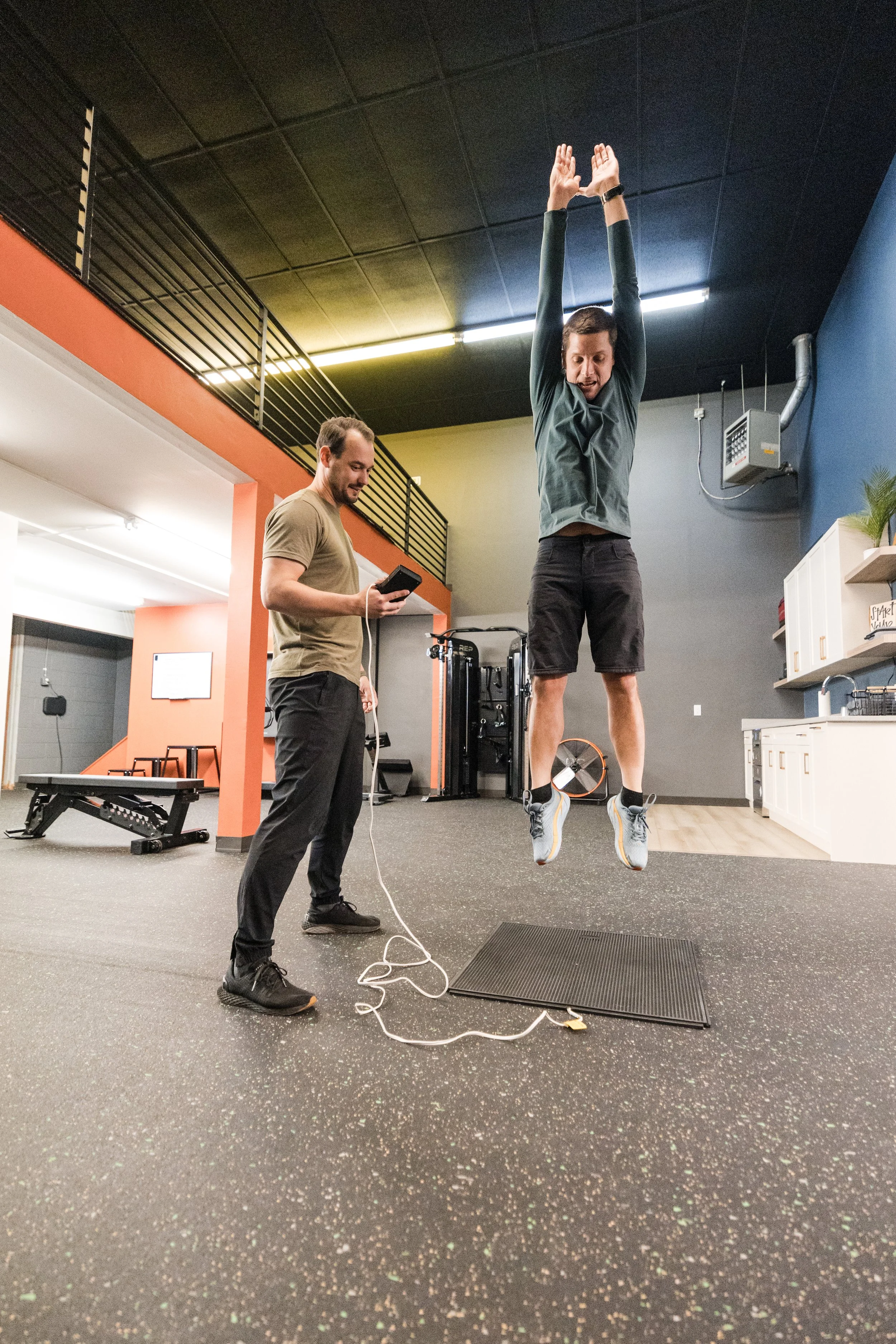
Plyometrics refer to a group of movements that help us improve speed-strength qualities. They involve fast, powerful movements that utilize a phenomenon known as the stretch-shortening cycle, in which the involved muscles rapidly lengthen (stretch) and then immediately rapidly contract (shorten).
Plyometrics include:
Jumps: taking off and landing on both legs
Bounds: taking off from one leg and landing on the other
Hops: taking off from one leg and landing on the same leg
How Are They Good for Joints?
Plyometrics have been shown to reduce incidence of injury. This happens through 3 primary mechanisms:
Increasing the tolerance of muscles and tendons to rapidly stretch
Many injuries occur when muscles are over-lengthened during landing and deceleration tasks. Plyometrics increase the capacity of our muscles and tendons to handle rapid stretching and shortening, such as when we jump and land repetitively.
Increasing reactivity in unexpected situations
Because plyometrics happen at high speeds, they improve our ability to react and respond in unpredictable environments, such as taking a quick step to dodge a pothole on a run, landing upright after missing a step, or cutting away from a defender on the field.
Increasing ability of joints to accept and manage high force
Take the knee joint as an example. During everyday activities like walking, the knee experiences forces of about 2–3 times body weight. When running, this increases to roughly 6–8 times body weight, and during jumping, forces can reach as high as 10–11 times body weight.
Plyometric exercises intentionally expose the body to these higher forces in a controlled manner. Because they exceed the demands of normal daily movement, they challenge the knee joint and surrounding tissues to adapt. With appropriate progression and dosage, plyometrics help build the knee’s capacity to tolerate and manage these high levels of force. They improve how the body distributes and transfers force across multiple joints and over time, this leads to better impact tolerance and more efficient movement mechanics.
How Do They Improve Performance?
Plyometrics train the body to produce high force (strength) at high speed (velocity) in the shortest possible time. This ability is a key component of efficient, athletic movement.
Plyometrics improve movement efficiency by:
Increasing rate of force development, how quickly you can generate force, making you more explosive.
Training muscles and tendons to store and release elastic energy more effectively, resulting in quicker reaction times.
Improving force transfer through multiple joints, which means better coordination.
Plyometrics done correctly will make you a faster runner, a better lifter, and a more agile skier. Including some variation of jumps, bounds, and hops in your training will result in better utilization of energy, reactivity, and contribute to healthier, more resilient joints.
How Should I Include Them in My Workouts?
Plyometrics place a high level of impact on the joints, so they need to be programmed strategically to maximize benefits while minimizing unnecessary stress. Because these are high-intensity movements, you don’t need much volume—typically 5–15 minutes, 2 times per week is enough to improve performance and reduce injury risk. In this case, less is more. Once jump quality drops (slower, noisier landings, poor control), the set should end. Plyometrics are about power and reactivity, not fatigue.
If you’re new to plyometrics, start with simple movements like pogo jumps and focus on landing mechanics and control. As you become more advanced, your plyometric training should become more specific to your sport.
One of the most effective ways to incorporate plyometrics is through contrast training, where you pair a strength movement with a similar explosive movement—for example, a squat with a squat jump or a deadlift with a broad jump. This approach improves the transfer of strength to power, reinforces movement patterns, and makes your training more time-efficient.
Key Takeaways
Plyometric training refers to a group of movements including jumps, bounds, and hops, which utilize a rapid muscle stretch, followed by a rapid muscle contraction, or shortening.
Plyometrics reduce injury risk by improving the capacity of joints and muscles to handle rapid stretch, higher levels of force, and react quickly in unexpected situations.
Plyometrics improve sport performance by increasing efficiency of movement, sharpening reactivity, and improving coordination.
Adding a few plyometric movements into your weekly routine is often enough to reap the benefits of better performance and lower incidence of injury.
Helping athletes RESOLVE THEIR PAIN by CLEARLY DEFINING THE PROBLEM and IMPLEMENTING EFFECTIVE SOLUTIONS to get them back doing the activities they love!
If you are currently struggling with an injury or unable to perform in the activities you enjoy. Please follow the link to schedule a consultation call to discuss how we can help you.