The Hardest Patient to Rehab in Physical Therapy
Let’s talk who actually is the hardest patient to rehab in physical therapy.
In my opinion it’s not an ACL reconstruction working their way back to the field. (although they have their own challenges as well……)
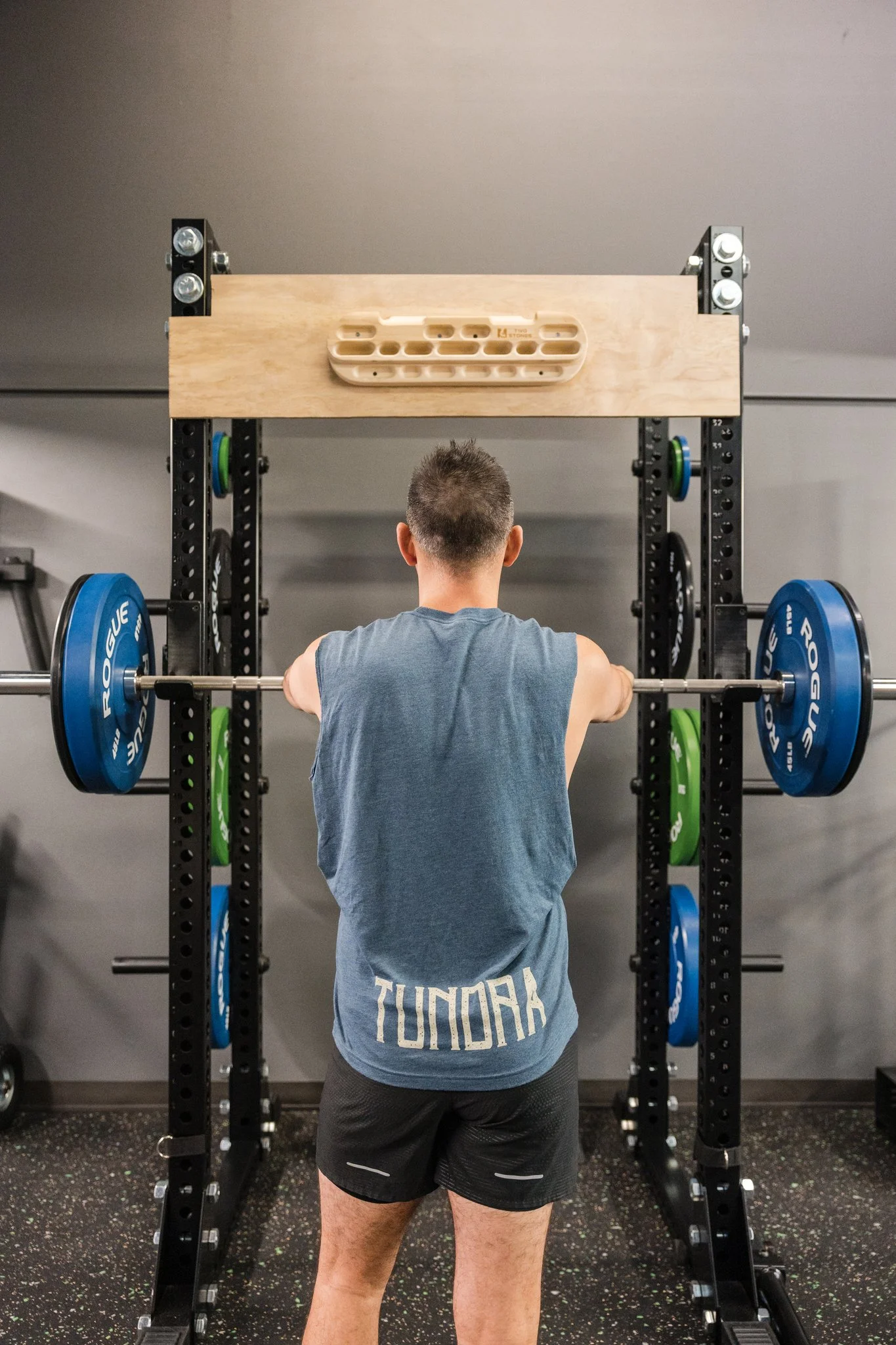
It’s a post-op powerlifter who squats, benches, and overhead presses more than a normal person can fathom.
Let’s talk about it.
THE PROBLEM
Post-op protocols are built upon traditional interval based progressions, weight restrictions, and intensities relative to tissue healing timeframes and their failure points.
Fine. I support this. Research driven. All good.
This works just fine for the normal person, and maybe even a field sport athlete. But how does this even compare when the patients prior experience involves overhead pressing #250, benches #400, and deadlifts #650. Which are not outrageous numbers in this population.
Once you hit the loading phase for these patients:
1) Where do you even actually begin?
2) What intensities do you anchor to?
3) How quickly do you progress back to their prior training intensities?
We recently had post-op powerlifter s/p shoulder labral reconstruction and this was our exact situation.
Before we get to what I did, here’s what helped shaped my decision making process.
THE RESEARCH
In 2022, the International Journal of Sports Physical Therapy published a case study by Dan Lorenz who documented his experience in rehabbing a competitive strongman following a distal biceps tendon repair.
If you treat weightlifters like we do, you come out the other side of this article feeling very seen when it comes to the challenges that exist in rehabbing these patients 😆.
I used his framework as a starting point and built from there.
So what did I do for this patient?
THE SOLUTION
First, we anchored all newly introduced lifts to 30% of their 1 RM and allowed working up to 50% 1 RM given no pain, no straining in the post surgical area and capacity to maintain proper form and lifting technique.
This was based upon looking to achieve a baseline stimulus for adaptation set forth by ACSM that 50% of 1 RM will at least provide an endurance muscular adaptation for a normal population, while for our situation allow the patient some form of working load they could bite into.
For this patient in particular, his prior overhead press was #250, thus our first day was beginning with an opening weight of #75 (30% of his 1 RM) and worked up to #115 that day using a base 5 rep scheme.
From there, we added roughly 5% per week.
So 50% to 55%, 55% to 60% and so forth, almost using them as checkpoints, and anchoring to our same considerations of pain, straining, and continuation of proper form and technique.
We found that once we hit 70% of his previous 1 RM we were able to achieve traditional states of fatigue and failure following his surgery, and were able to program with traditional methodologies and progressive overload concepts accordingly.
This was supplemented with an absurd amount of BFR work to replicate previous lifting intensities and objectives not only muscle adaptations but also maintain a semblance of sanity for the patient in rebuilding back.
We followed this same approach across all other compound lifts.
Bench, deadlift, row, and pull ups.
So where did this case leave me……?
KEY TAKEAWAYS
First, I’d challenge any clinician and patient going through this process, when it comes to loading parameters and programming, you have to go past:
“Don’t go too heavy” or “Be careful”
Patients of this experience need guidance. They need specificity to make better choices for themselves in their rehab, otherwise we leave the door open for other variables affecting the outcomes we want to achieve.
Second, we need to be considerate to the patient in front of us. A #10 lifting restriction to a traditional patient is not the same as someone who has the ability to lift #250 above their head.
There exists an opportunity cost to the patient losing valuable time and sessions being under loaded if we aren’t exploring what’s best for our patients.
It’s up to us to provide the runway for them to be successful.
Are your restrictions actually protecting the tissue, or are they protecting you from having to individualize the program to your patient?
Because the repair site doesn’t know how strong your patient is. Your programming should.
Helping athletes RESOLVE THEIR PAIN by CLEARLY DEFINING THE PROBLEM and IMPLEMENTING EFFECTIVE SOLUTIONS to get them back doing the activities they love!
If you are currently struggling with an injury or unable to perform in the activities you enjoy. Please follow the link to schedule a consultation call to discuss how we can help you.