Arch Nemesis: Your Guide to Posterior Tibialis Tendinitis
If you've got pain along the inside of your ankle or arch that flares up during running, cutting, or long days on your feet, there's a good chance the posterior tibialis tendon is the culprit. It’s a very common overuse injury in active people and when untreated has a habit of lingering for months or sneaking back the moment you work back into intensity in your training. Treated right and treated early, most athletes make a full recovery quite quickly.
Here's what's going on, and how we build the rehab.
What Is the Posterior Tibial Tendon, and Why Does It Matter?
The posterior tibialis muscle runs down the back of your shin, wraps behind the inside ankle bone (the medial malleolus), and anchors into the bottom of your foot. Its job is to control and support the arch of your foot, absorb forces and control pronation as your foot hits the ground when walking, and help drive push-off when you run, jump or change direction. Every stride you take, it's cooking baby.
Because it does so much repetitive work, and because its function is so prominent with standing, walking, and running, it's prone to overload injuries.
Who Gets It, and Why
This isn't just a middle-aged, flat-footed person's injury. We see it in:
Runners, racquet-sport athletes, or field-sport athletes ramping mileage or intensity too quickly. Athletes with a flatter or more pronated foot type, which increases demand on the tendon with every stride. People returning to training after a layoff, a new shoe, or a change in playing surface. Anyone with risk factors like tight calves, weak hip/glute control, obesity, diabetes, or a history of ankle sprains.
The common thread is a mismatch between workload and capacity, the tendon was asked to do more than it was prepared for.
Symptoms to Watch For
Pain and swelling along the inside of the ankle and arch, especially just below and behind the medial malleolus. Pain that builds with activity: running, jumping, prolonged standing, and eases with rest early on. A feeling of weakness or fatigue in the arch, or the arch visibly flattening more than usual. Difficulty or pain performing a single-leg heel raise on the affected side. In more advanced cases, a visible change in foot shape (more of a "flat foot" appearance).
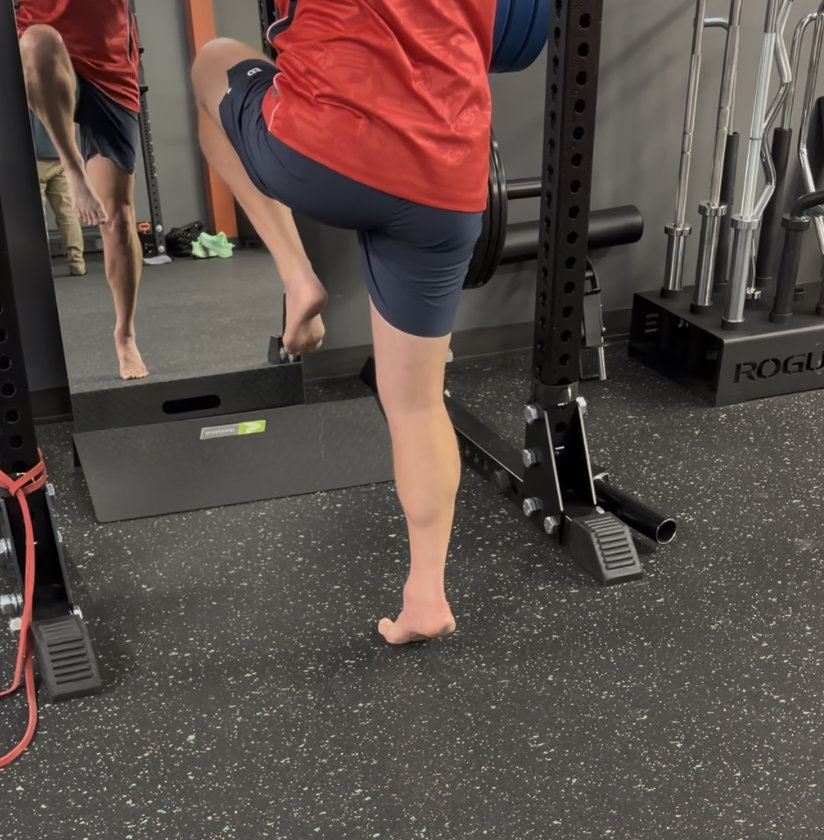
That single-leg heel raise is worth remembering, it's the single most reliable clinical test we use, both to diagnose the problem and to track recovery. Pain, weakness, or an inability to complete a clean rep on the involved side is a strong signal as it’s a precursor to what the demands of the foot can be when advanced to running and changing directions.
The Keys to a Proper Rehab
The biggest mistake we see is either total rest (the tendon detrains and the problem returns the moment training resumes) or pushing through pain (the tendon never gets a chance to remodel). The fix is progressive, monitored loading, dosing the work correctly, not stopping and not ignoring it. Here’s what matters:
It's all about the arch. Controlling pronation has to be addressed across the entire rehab, not just at the beginning. The posterior tibialis is the arch's primary dynamic stabilizer and if you never restore control of pronation, the tendon never gets strengthened in the position it actually has to work in. Skip this piece and running or changing direction becomes exponentially harder later, because those movements load the arch with forces several times higher than standing strength work ever will.
Build concurrent calf strength. The posterior tibialis doesn't work in isolation. The gastroc and soleus share the load through push-off and absorb a large share of running and cutting forces. Progressing calf raises alongside your inversion and arch work builds the surrounding capacity the tendon needs to hold up under real training demands.
Don't skip the hips. Weak hip and glute control lets the knee and ankle collapse inward, driving the exact pronation pattern that overloads this tendon. Strengthen the tendon without addressing the hips, and you're potentially rebuilding on the same faulty mechanics that caused the problem.
Restore tolerance to impact. Standing strength is not the same as running strength. Before returning to sport, the tendon needs to be progressively exposed to the higher, faster loads of hopping, bounding, and running, built up gradually so the tissue is actually prepared for the forces it'll see on the field or the road.
When to See a Physical Therapist
Self-managing the early load modifications for a week or two is reasonable. See a physical therapist promptly if pain is worsening, your arch is visibly flattening or not returning to normal shape when off your feet, you can't perform a single-leg heel raise at all, or symptoms haven't meaningfully improved after a few weeks of modified activity. Getting the loading dose right early is what separates a 6-8 week recovery from a 6-month one.
The Bottom Line
Posterior tibial tendinitis responds well to the right rehab, and poorly to the wrong one. Total rest and pushing through pain both tend to backfire. What works is accurately identifying where you are, calming the tendon down without deconditioning it, rebuilding strength and capacity in a structured sequence, and using objective benchmarks, not just "it feels okay," to decide when you're ready for the next phase, and ultimately, back to full training.
Want to See an Someone in Real Life with This
Here’s a snippet of a session with one of our clients. HERE!
If this sounds like something you're dealing with and having difficulty with running, cutting, or long days on your feet. Our team can evaluate what's driving it, build a custom rehab plan built around you and your training schedule, and get you back to running and competing without it coming back.
KEY TAKEAWAYS
Don't treat it as either total rest or push-through-pain — both backfire. Recovery relies on progressive, monitored loading that keeps the tendon working without overloading it.
The single-leg heel raise is the key diagnostic and progress marker. Pain, weakness, or inability to complete one on the affected side signals the problem — and tracks recovery over time.
Rehab has to be comprehensive, not just tendon-focused. It needs arch/pronation control throughout, concurrent calf strength, hip/glute work to prevent knee-ankle collapse, and a final phase rebuilding impact tolerance (hopping, bounding, running) before return to sport.
Helping athletes RESOLVE THEIR PAIN by CLEARLY DEFINING THE PROBLEM and IMPLEMENTING EFFECTIVE SOLUTIONS to get them back doing the activities they love!
If you are currently struggling with an injury or unable to perform in the activities you enjoy. Please follow the link to schedule a consultation call to discuss how we can help you.