Ski season is coming, and along with it one of the most common knee injuries we see, MCL sprains.
Catch an edge, or maybe take a hit to the outside of your knee on the field, and the ligament on the inside of your knee can get stretched past its limit.
Here’s the good news, most MCL sprains heal really well without surgery. A proper rehab gets you back faster, and it leaves your knee stronger and more resilient than before you got hurt. These are the five keys we focus on in our performance physical therapy.
What does the MCL do and how it gets hurt
The medial collateral ligament (MCL) runs along the inside of your knee, connecting your femur to your tibia. Its main job is resisting what we call a valgus force, or in other words, prevents the knee from collapsing inward. Beyond that, it also plays a small role in controlling knee rotation.
Most MCL sprains come from one of three things:
• A blow to the outside of the knee that drives it inward (tackles, collisions, falls)
• A twisting, knee-in moment on a planted foot (cutting, pivoting, landing)
• A caught edge on skis, especially the classic snowplow-gone-wrong, where the ski runs away and the knee gets pried open
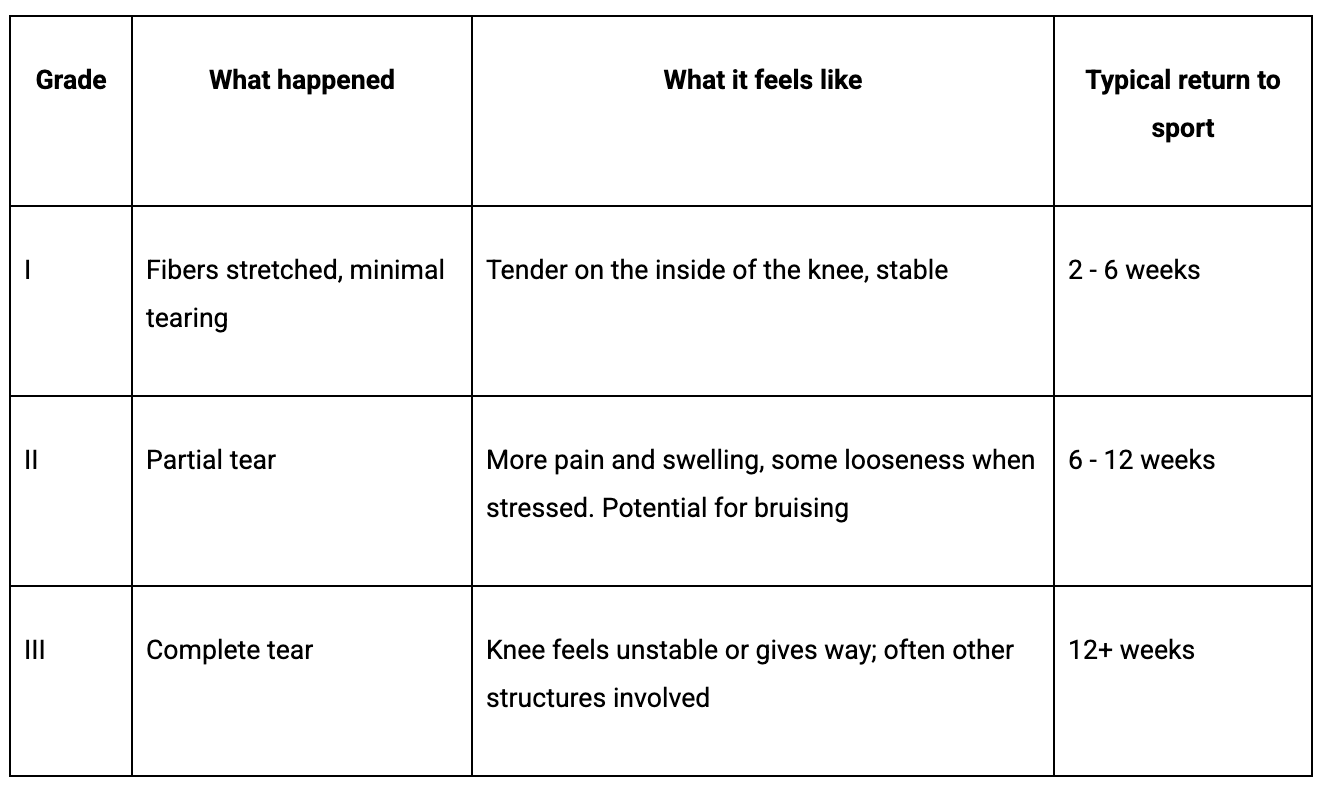
MCL sprains are graded by how much damage the ligament took →
Gentle reminder that these timelines are ranges, and individual considerations play a role in any recovery. Which brings us to our keys to a proper rehabilitation of an MCL sprain.
Key 1: Protect the MCL
The MCL has a great blood supply, which is why it heals so well on its own. But ligaments heal best under the right amount of stress, not zero stress.
In the first week or two, the goal is to protect the ligament from the motion that hurt it (that inward force) while keeping everything else moving:
Brace if needed. Grade II and III sprains often do well in a hinged knee brace that blocks side-to-side stress but still lets the knee bend and straighten.
Get weight through the leg as soon as tolerated. Crutches are a short-term tool and can be handy early on.
Manage swelling with compression, elevation, and gentle motion. Swelling shuts down your quad, and a shut-down quad can SLOOOOOWWWWW everything down.
Keep training what you can. Upper body, the other leg, core, and bike once you have the motion. Fitness lost now is fitness you'll have to rebuild later.
Key 2: Get movement back and the return of the Quad
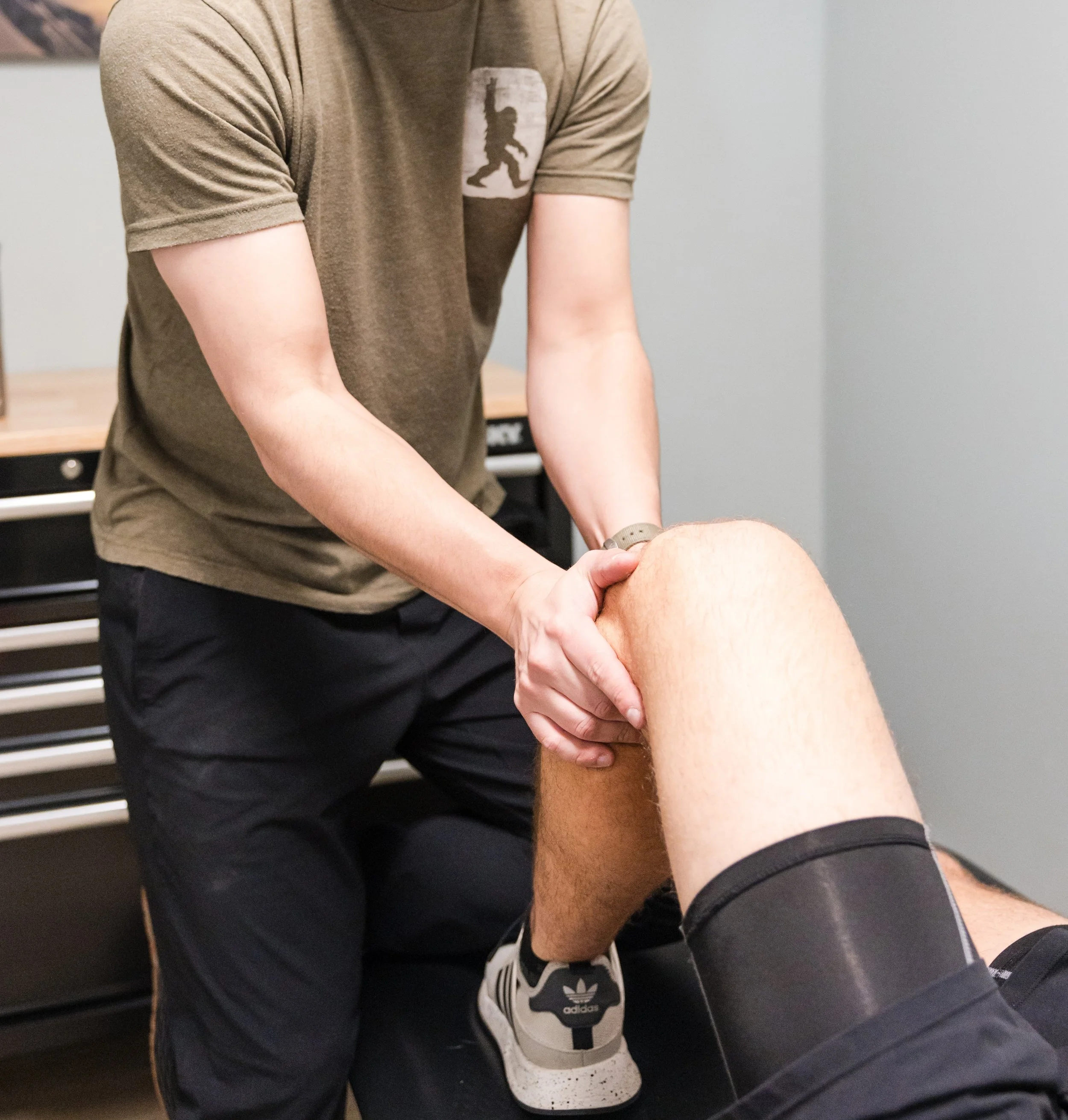
Two things really set the table and predict how the rest of your rehab goes: whether your knee fully straightens, and whether your quad turns back on.
A knee that doesn’t fully extend changes how you walk, run, squat, ski, and snowboard. Bending usually comes back fairly quickly and reasonably; straightening often needs a roadmap and some encouragement.
Getting your quad back is the other early priority. After a knee injury, the brain partly shuts it off to protect the joint, which we call inhibition. Quad sets, straight leg raises, leg extensions, and electrical stimulation help wake it back up. Once you can tighten the quad fully and lift the leg with no lag, you're ready to start working for real.
Key 3: Build real strength, and measure it
This is where most MCL rehabs can fall short or plateau when working with the wrong rehab team. The pain is gone, the knee feels stable, and the athlete is told to "ease back in."
But pain-free is not the same as strong.
The ligament isn't the only thing protecting your knee from collapsing inward. The muscles around it do a lot of that work, and they have to be trained like it:
Quads and hamstrings to control the knee under load
Glutes and hip rotators to keep the knee from diving in when you land, cut, or carve
Calves and adductors, which are often forgotten and matter a lot for skiers and runners
We progress from simple, compound lifts to heavy, single-leg work: split squats, step-downs, single-leg RDLs, copenhagens, curtsy lunges. We prioritize unilateral training matters here because the injured leg will happily let the healthy leg do the work on anything bilateral.
And we don't guess. We test strength with a dynamometer, comparing the injured side to the healthy side and to research-based norms for your sport. "Feels good" is a starting point. Numbers tell us when you're actually ready to progress.
Key 4: Getting back to the mountain
An MCL sprain is a side-to-side, twisting, and pivoting injury. A rehab that only moves forward and back leaves you unprepared for the rest of what skiing and the field can expose you to.
Once the strength base is there, we layer in:
Lateral work: shuffles, lateral bounds, skater hops, banded lateral stepping
Deceleration and landing: drop landings, stick landings, controlled stopping from a jog or sprint
Rotation and change of direction: pivots and cuts that start slow and planned, then get faster and reactive
Sport-specific demands: carving-style edge loading for skiers, uneven terrain and descents for trail runners, heavy loading with a controlled knee path for lifters
The goal is to train a knee that goes where we want it to go. Or perform how we want it to perform when things get fast and unpredictable, because on the mountain or the field where things get messy, we want a knee that we can count on and has been there before.
Key 5: Return criteria, not just a calendar
"Six weeks" is not a return-to-sport test. Time tells us the ligament has had a chance to heal. It doesn't tell us whether you can handle what your sport throws at you.
Before we clear an athlete to go back to full skiing, cutting sports, or heavy lifting, we want to see:
Full, pain-free range of motion, specifically full extension
No swelling after hard training sessions
No pain or laxity when the ligament is stressed
Strength in the injured leg within about 10% of the healthy side, and in range of normative torque values
Clean hop and landing tests with good knee control
Confidence, the athlete trusts the knee at higher speeds and forces
Hit those, and we’re not just back. You're more resilient than before the injury.
Get back to the mountain the right way
An MCL sprain doesn't have to cost you your season. With the right plan, most athletes come back strong and stay that way.
We work with skiers, runners, trail athletes, and lifters every day, and we build MCL rehab around what you actually need to get back to. If you've tweaked your knee, or you're "healed" but it still doesn't feel right, book an evaluation and let's get you back on the mountain.
Helping athletes RESOLVE THEIR PAIN by CLEARLY DEFINING THE PROBLEM and IMPLEMENTING EFFECTIVE SOLUTIONS to get them back doing the activities they love!
If you are currently struggling with an injury or unable to perform in the activities you enjoy. Please follow the link to schedule a consultation call to discuss how we can help you.