Colorado Ski Prep Guide: How to Strengthen Your Legs for Skiing and Snowboarding
Ski and snowboard season is beckoning upon us. Last year's snowfall was disappointing but how can you not enter this season with a new found optimism and enthusiasm. Hopes and dreams for 12+ inches of powder, freshies in the afternoon, and a banging apres party after a hard day on the slopes. This is the year you get stuck behind Vail pass, no way of getting home, get hit with a fresh snowstorm and you're stuck riding the best powder you’ve seen in 10 years.
You need to be ready for all of it and now is the time to start prepping for it.
This post dives into the training qualities that gets most overlooked in prep.
I’m talking eccentrics and isometrics: why they matter, how to build them into your training, and the exercises we actually use with skiers and snowboarders in the clinic.
Why eccentrics and isometrics matter
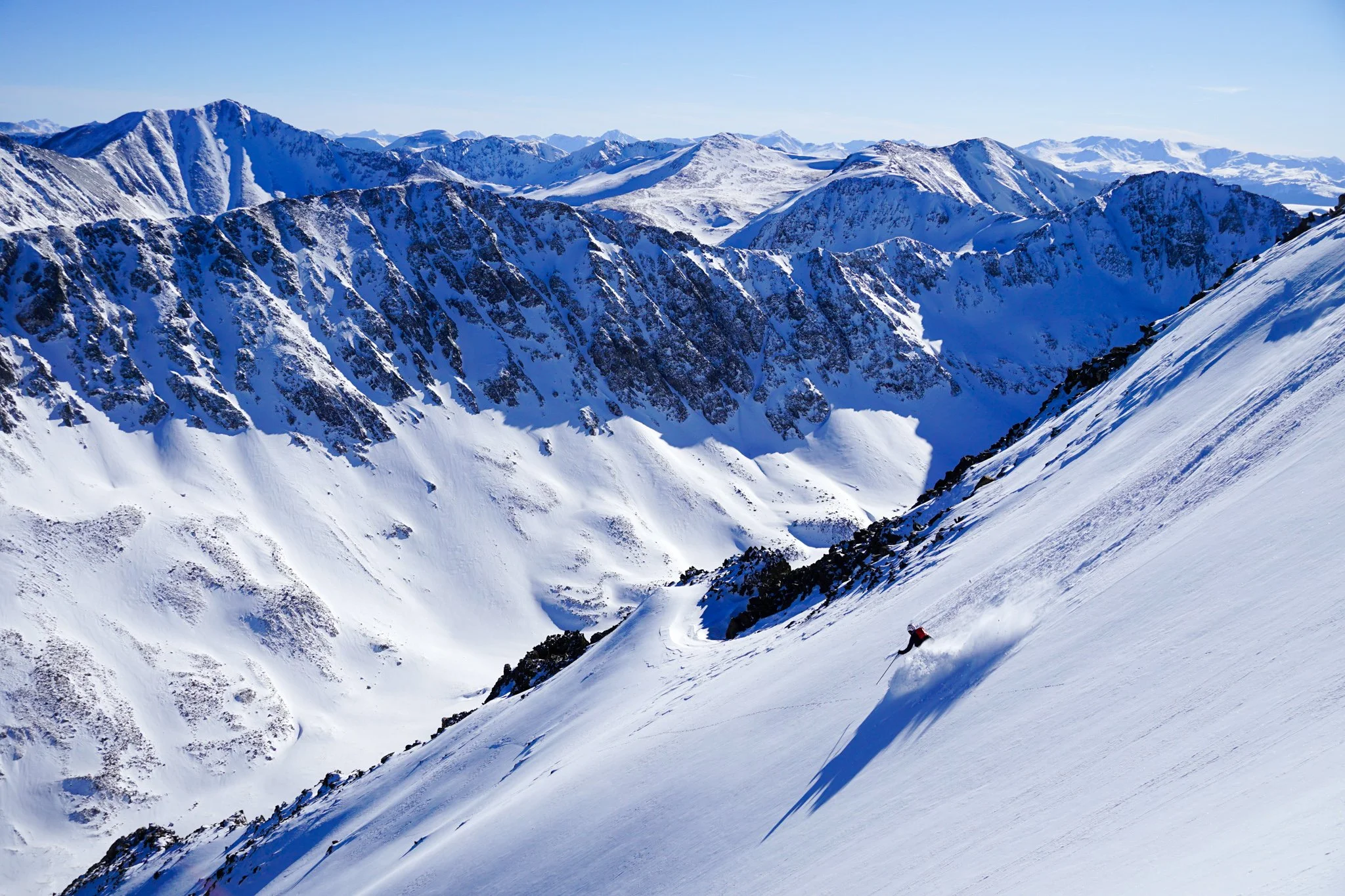
Most of what your legs do on skis or a snowboard is resist and control.
Here's what I mean. As you load into a turn, your quads lengthen under tension to control how far you sink (eccentric). Then they hold you in a flexed position while forces build through the arc of your turn (isometric). We finish by quickly “standing up” to set up for our next pass (concentric).
Most of skiing and snowboarding is made up of high force eccentric and isometric contractions and the prep needs to match. EMG research on giant slalom racers going back to the mid-1990s found a clear predominance of eccentric over concentric quad activity, and later studies have reported outside-leg muscle forces reaching 100–150% of maximal voluntary contraction during a turn (Berg et al., 1995, cited in Gross et al.; Kröll et al., JSSM). Recreational skiing is less extreme, but the pattern is the same.
Does being generally stronger help these qualities? Absolutely.
Does training these qualities specifically make us even better at them? 100%.
How to work it in your programming
You don't need a new program. We just need to tweak how you do a few lifts you probably already do. There are four main levers we can use.
1. Slow the lowering (tempo). Take 3–5 seconds on the way down on squats, split squats, or step-downs. Same exercise, completely different stimulus. Write it as a tempo like 4-1-1: four seconds down, one second pause, one second up.
2. Hold at ski angles (isometrics). Pause or hold in the range you actually ski and snowboard in, roughly 60–100° of knee bend. Use two flavors:
Heavy and short: 3–5 holds of 20–30 seconds at a hard effort. Builds strength at the angles we love.
Moderate and long: 2–4 holds of 45–90 seconds. Builds endurance to finish a long run without your legs shaking.
3. Overload the eccentric. Lower more than you lift. Examples: lift up with two legs and lower with one (2-up, 1-down leg press, smith machine, or step downs). When done correctly, you should hypothetically not be able to lift "up" on the given weight and only be be able to control the lower. This to me is the most potent option but sometimes comes with a learning curve.
4. Make it single-leg. Skiing and snowboarding loads one leg at a time. Most of your eccentric and isometric work should eventually live on one leg, which also forces the knee-over-foot control that long term protects your knees.
Where do they fit in a session
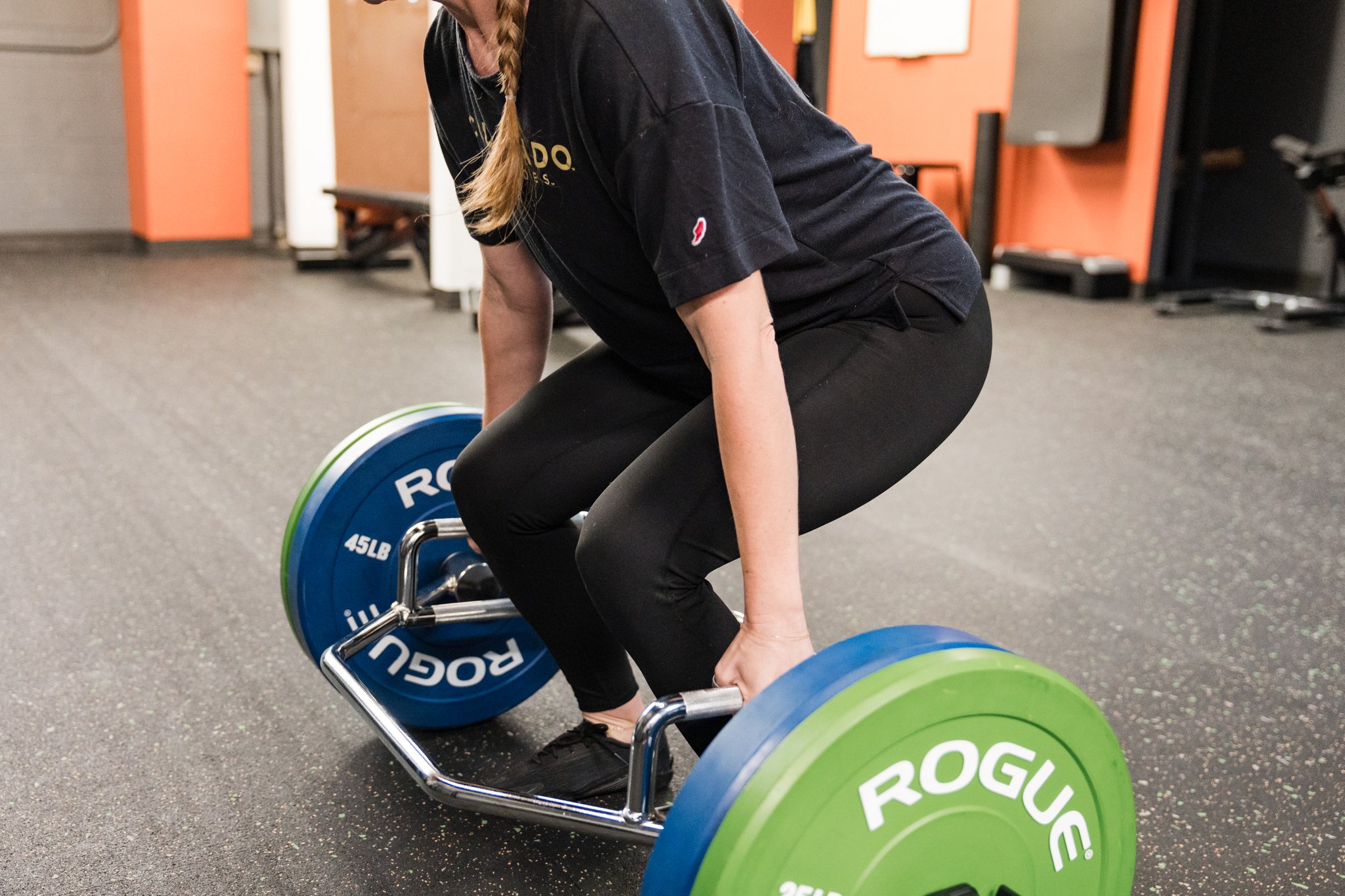
Few different options, all correct. Find the one that makes sense to you.
1. Warm-up: a short isometric hold (wall sit or Spanish squat) wakes up the quads and is often kind to cranky knees.
2. Main strength lift: heavy squat, trap bar deadlift or split squat, with a controlled 3-second lowering.
3. Accessory block: your tempo single-leg work and eccentric-overload exercises.
4. Finisher (optional): a long isometric hold or a timed density circuit to train fatigue resistance.
How often
Two lower-body sessions per week is the sweet spot for most recreational skiers. One can lean heavy (strength plus tempo), the other can lean endurance (longer holds, circuits). Three is fine if you plan it out and recover well, but more isn't always better if your legs are sore every time you show up.
Examples of what we use in the clinic
These are not all encompassing and listed roughly from easiest to most demanding. Start where you can own the position, not where your ego wants to begin.
Exercise: Wall Sit
Type: Isometric
Prescription: 3 × 45 - 60 sec
Key to Success: Knees at roughly 90°, weight through the whole foot
Exercise: Spanish Squat
Type: Isometric
Prescription: 4 × 30 - 45 sec
Key to Success: Sit back into the band, shins vertical, chest tall
Exercise: Tempo Goblet or Front Squat
Type: Eccentric
Prescription: 3 × 6, 4 sec down
Key to Success: Control your trunk, don't drop chest in the bottom
Exercise: Tempo Rear-foot-elevated Split Squat
Type: Eccentric, Single-leg
Prescription: 3 × 6, 4 sec down
Key to Success: Front knee tracks over the middle toes
Exercise: Lateral Step-down From a Box
Type: Eccentric, Single-leg
Prescription: 3 × 8, 3 sec down
Key to Success: Hips level, knee doesn't cave in
Exercise: Isometric Split Squat Hold (loaded)
Type: Isometric, single-leg
Prescription: 3 × 30 sec each
Key to Success: Hold at your ski depth, heavy enough to shake by the end
Exercise: Reverse Nordic
Type: Eccentric
Prescription: 3 × 5, slow
Key to Success: Lean back from the knees as one plank; stop before your hips break
Exercise: 2-up, 1-down Leg Press
Type: Eccentric overload
Prescription: 3 × 5, 4 sec down
Key to Success: Press with both legs, lower with one
Sample sessions
Session A: strength and control
Spanish squat hold, 2 × 30 sec (warm up / prep)
Tempo front squat, 4 × 5, 4 sec down
Tempo rear-foot-elevated split squat, 3 × 6/side
Single-leg Romanian deadlift, 3 × 8/side
Reverse Nordics, 3 × 6
Session B: ski endurance (about 30 min)
Curtsy step-downs, 3 × 8/side
2-up, 1-down leg press, 3 × 5/side
Ski-circuit, 3–4 rounds with 90 s rest:
Wall sit, 30 sec
Skater squat pulses, 15 sec/side
Alternating split jumps 5-10/side
The bottom line
Your quads make or break you on the mountain. Train them to absorb, train them to control, and train them to last. If you start now, opening day will feel like you're already in core season shape.
Want your quads tested before the season, or a preseason program built around your skiing and your knees? Book an evaluation and we'll build it with you.
Helping athletes RESOLVE THEIR PAIN by CLEARLY DEFINING THE PROBLEM and IMPLEMENTING EFFECTIVE SOLUTIONS to get them back doing the activities they love!
If you are currently struggling with an injury or unable to perform in the activities you enjoy. Please follow the link to schedule a consultation call to discuss how we can help you.