Inside the OR: What Two ACL Reconstructions Taught Us
We spend months with ACL patients after surgery. We rarely get to see the 90 minutes that set the rehab in motion.
This past week we had the opportunity to scrub in and participate in surgery with Dr. Mitchel Robinson, a local orthopedic surgeon from Panorama Orthopedics in Golden, and his team. During our day in the OR, we were able to observe 2 different ACL-reconstructions and discuss not only the surgery itself but the considerations that went into them.
Here were my 3 takeaways from the day and how each one may shape what your rehab may look like following:
Takeaway 1: There's no "best" graft, only the best graft for you
The graft decision isn't made on the operating table. It's made weeks earlier in the consultation and it's based on age, sport, activity level, anatomy, and surgeon experience and preference. What we saw in the OR was the result of that conversation.
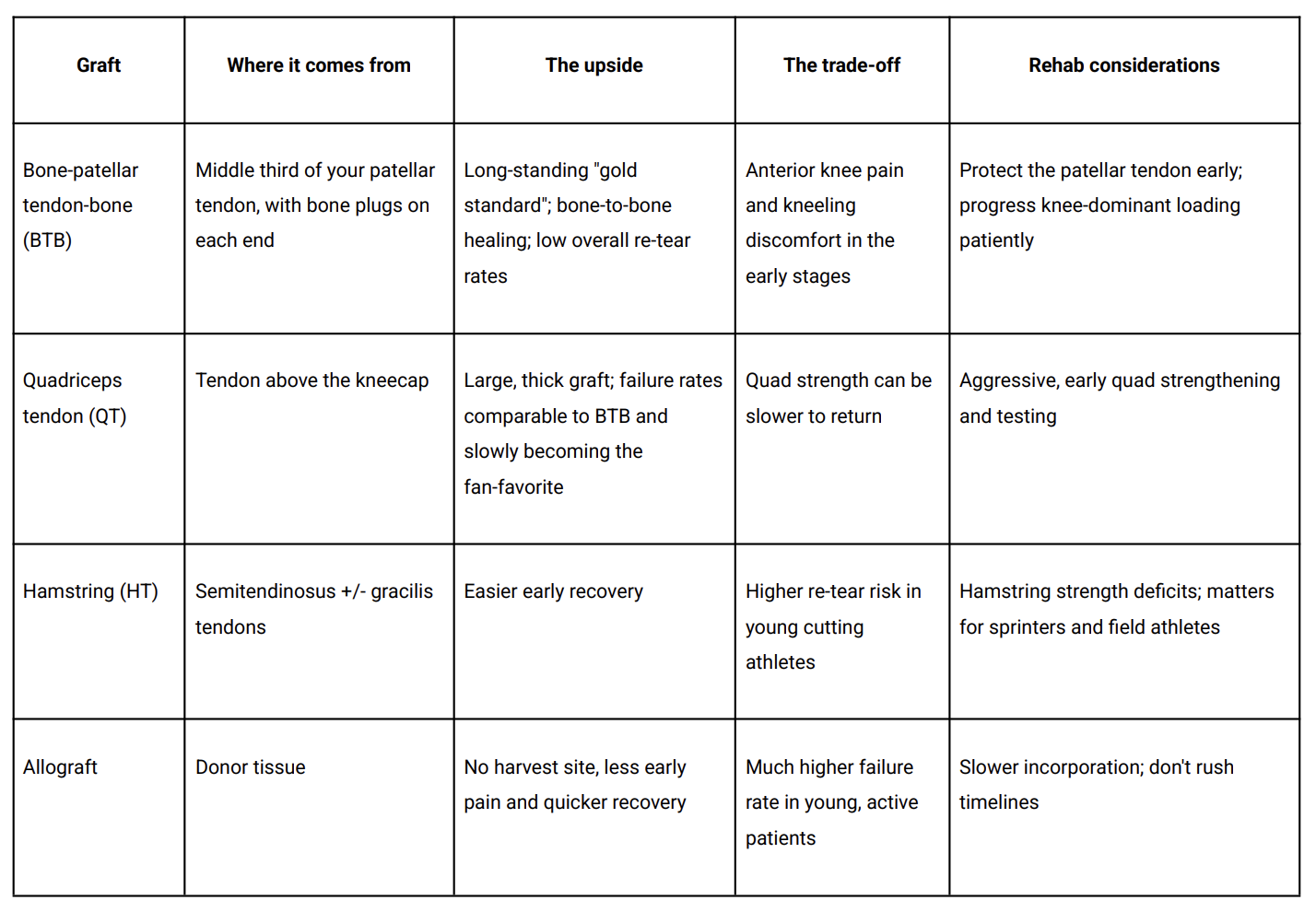
I’ve written a more detailed synopsis on the different graft options HERE if you wanted a deeper dive on each, but here’s a quick summary of the 4 options:
The Research Behind Graft Selection:
Quad tendon is the rising star. A recent meta-analysis in athletes found QT and BTB comparable for graft failure, return to sport, and function (Journal of Orthopaedic Experience & Innovation). Long-term data is still catching up, which is exactly what the STABILITY 2 trial is testing (ClinicalTrials.gov).
BTB beats hamstring in high-risk athletes. A risk-stratified comparison found BTB re-rupture rates were significantly lower than hamstring in the high-risk group, but similar in lower-risk patients (PMC12864351).
Age is the biggest risk factor, and allograft can magnify it. In the MOON cohort, allografts had about 4x the odds of rupture compared to autografts, and each 10-year drop in age more than doubled the odds of failure (Kaeding et al.). One study found allograft failure rates nearly 3x higher in patients 34 and younger (Arthroscopy, Sports Medicine, and Rehab). Demographics and history can make this a great choice for the right patient.
What Does This Mean for Rehab:
The graft selection is the first choice and sets the wheels in motion to considerations to your rehab. A BTB patient needs a smart plan for patellar tendon load consideration. A QT patient needs early relentless quad work while navigating graft site irritability. A hamstring patient needs us tracking knee flexion strength long after the knee "feels fine." Same surgery, individualized rehab.
Takeaway 2: The internal brace is a seatbelt, not a shortcut
An internal brace is a strip of high-strength suture tape anchored alongside the new graft. Think of it as a seatbelt for the ACL while the graft goes through its weakest phase.
Here's why that matters. After surgery, a graft doesn't just "heal." It remodels from tendon tissue into something that behaves like ligament, and it loses strength along the way before it gets stronger. That window is when an unexpected slip, twist, or overzealous rehab session can stretch or tear it.
After discussing further with the individuals on-site for surgery, the initial concern when internal bracing first began, was placing a foreign tissue inside that the body may reject. After re-working the material, the internal brace is now made up of the same material used in traditional sutures that have been found to be successful across years with high success rates.
The Research Behind Internal Bracing:
The biomechanics are strong. Lab studies show suture tape increases the construct's strength and reduces graft stretching under repeated loading, without stress-shielding the graft (AJSM 5-year follow-up; Scientific Reports).
Early clinical results encouraging. A case series of 252 patients reported a graft failure rate under 1% (PubMed 37451280). A 2026 matched cohort in high-risk hamstring patients found 0% failure with augmentation vs 12.9% without (AJSM).
Evidence still young. Several cohort studies found no difference in graft rupture rates with tape (PMC11967987), and randomized trials are still underway (STACLR, NCT05532189).
Brace + reconstruction is not the same as brace + repair. Using tape to repair the torn ACL itself (no new graft) has shown higher failure rates than reconstruction (PMC11665408). What we observed was augmentation of full reconstructions.
What Does This Mean for Rehab:
The tape protects the graft mechanically and as I always say, you cannot beat biology. Graft remodeling still takes time, so your return-to-sport decision should still be driven by strength, hop testing, and time, not by the hardware. Where the brace helps us is confidence in early loading and range of motion.
Takeaway 3: Where does the LET procedure fit into ACL-R
The ACL controls how far your shin slides forward and helps control rotation. Its what plays into that "giving way" feeling when you plant and cut. The planting and twisting mechanism is the typical way most ACLs tear, especially considering 70% of them are non-contact injuries.
Are there ways beyond exercise we can support this mechanism as a part of surgery?
That's where a lateral extra-articular tenodesis (LET) comes in. The surgeon takes a thin strip of the iliotibial (IT) band on the outside of the knee and anchors it to the femur. Acting as an extra support, looking to provide redundancy to rotational stability.
The Research Behind the LET:
The STABILITY trial that looked to change the conversation. In this randomized trial of 618 high-risk patients aged 14 to 25, adding LET to a hamstring ACL reconstruction cut graft rupture from 11% to 4% and clinical failure from 40% to 25% at 2 years (Getgood et al., AJSM 2020). It’s important to note findings were only only tested in hamstring grafts in this study. The STABILITY 2 trials expected to be published in the near future dive into QT and BTB failure rates.
Return to sport was similar between groups, so the added procedure didn't hold athletes back (PubMed 40308341).
It's selective, not routine. Current thinking, including the 2025 international consensus, reserves LET for higher-risk knees (Current Reviews in Musculoskeletal Medicine).
What Does This Mean for Rehab:
A LET adds a second surgical site on the outside of the knee. In the realm of surgery, increased trauma always plays a role in the initial recovery. Expect some lateral knee and IT band soreness early, and plan for it when restoring range of motion and quad strength. Long term, the expected payoff is a more rotationally stable knee.
The big takeaway: your surgery writes the first page of your rehab
While there can be a lot of overlap between one ACL reconstruction to the next when it comes to a patient’s rehab. Graft selection, prior history, or maybe an added LET each have their role in specific considerations to your recovery. That’s why at Tundra Performance and Physical Therapy, we believe so strongly in an individualized approach to your care in getting you back to the trails and training floor.
Facing an ACL surgery, or a few months out and not sure you're on track? Book an evaluation with our team and let's talk through it.
A huge thank you to Dr. Mitchel Robinson and his team at Panorama Orthopedics for being so welcoming and open to our team in the OR. If you're facing ACL surgery or need further consultation on a sports medicine injury in Denver, and looking for a surgeon who will prioritize you and your goals as an athlete, we can't recommend Dr. Robinson and the Panorama team enough.
Helping athletes RESOLVE THEIR PAIN by CLEARLY DEFINING THE PROBLEM and IMPLEMENTING EFFECTIVE SOLUTIONS to get them back doing the activities they love!
If you are currently struggling with an injury or unable to perform in the activities you enjoy. Please follow the link to schedule a consultation call to discuss how we can help you.