Beating Plantar Fasciitis: A Performance Physical Therapist's Playbook for Denver Athletes
If you've ever taken your first steps out of bed and felt a stabbing pain in your heel, you already know what plantar fasciitis feels like. It's one of the most common complaints we see in the clinic, whether the person in front of me is a marathoner, a weekend pickleball warrior, or someone who just started a new walking routine.
The good news, it's also one of the most treatable conditions we work with, as long as we attack the cause and not just the symptoms.
What's Actually Happening
The plantar fascia is a thick band of tissue running from your heel to the base of your toes. Its job is to act like a spring, storing and releasing energy every time your foot hits the ground. Plantar fasciitis develops when that tissue is asked to absorb more workload than it's prepared for, and it responds the way any overloaded tissue does, with irritation, micro-damage, and pain. Despite the "-itis" in the name, most chronic cases are less about active inflammation and more about a tissue that hasn't been given the right stimulus to perform, adapt, and strengthen.
How Does Plantar Fasciitis Start
In our experience, a few patterns show up again and again:
A sudden jump in training volume (new shoes, a new sport, or ramping up mileage too fast)
Limited ankle mobility that forces the arch to absorb workload the calf and ankle should be sharing
Weakness in the foot's intrinsic muscles and the calf complex leaving the fascia as the primary shock absorber
Long hours on hard, flat surfaces with little variation in workload
Where People Go Wrong
The most common mistake I see is chasing the pain too long while not treating the cause. Rolling on a frozen water bottle, stretching the calf, and resting for two weeks can quiet symptoms temporarily, but if the underlying capacity issue never gets addressed, the pain returns the moment activity ramps back up. Complete rest is rarely the answer either. Tissue needs progressive workload to adapt; it doesn't get stronger sitting on the couch.
To be perfectly clear, modalities and tools that offer us temporary relief are certainly appropriate. When you’re symptoms are elevated, and it fucking hurts, finding relief along the way is necessary. Eventually, there needs to be a transition of priority from management to adaptation. Never addressing the underlying causes leave you in a cyclic pattern of flare ups and frustration that things aren’t getting better. At the end of the day it becomes about leveraging tools for relief to open doors for progressive workload.
Plantar Fasciitis Prioritizations in Treatment
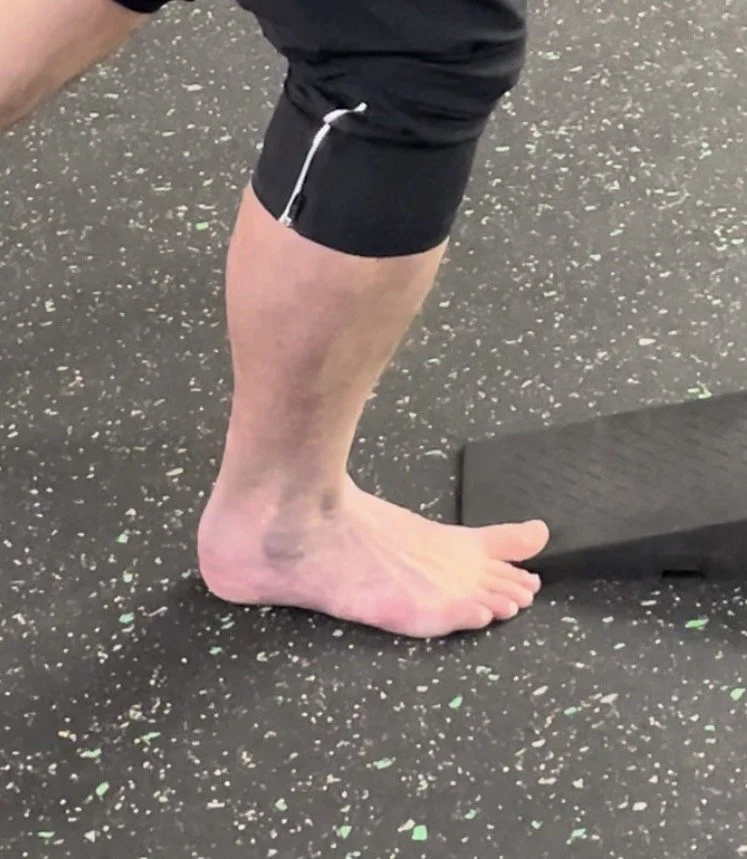
Here's the framework we use with patients, built around workload management and progressive strengthening:
Strengthen the foot itself. You will commonly hear us say, “big toe down.” We need to build the small muscles of the foot to support the arch day to day. This typically is treated with single-leg balance work, exercises with the strengthen big toe, and movements that challenge the arch medially and laterally.
Load the calf. While we certainly need to build back the small muscles of the foot to support the arch, however, the calf remains king of the foot and ankle complex. We start with isometric or slow, heavy calf raises (typically with the toes elevated on a towel or ramp) and progress to more intense variations for rebuilding the tissue's capacity.
Restore ankle mobility. A few minutes a day of ankle dorsiflexion work can take real strain off the arch and provide a more optimal environment to operate.
Rebuilding good stiffness. Strength work alone isn't enough to return you to running, jumping, or cutting. The tissue needs to be reconditioned to the specific speeds and forces of your activity through a progressive plyometric program. Think pogo hops, bounding, and change of direction drills, before you go back to full training. We need stiffness in sport to be powerful and fast, not addressing these qualities before returning can be the difference between long standing relief and flare ups in the future.
Typical Plantar Fasciitis Plan of Care
Most cases improve significantly within 6 to 12 weeks with a consistent plan. However, due to the nature of the foot being our first point of contact for walking, running, and being on our feet, pain can persist beyond that as it can become difficult to manage workload. That’s why it's worth it to book an evaluation earlier than later with a physical therapist to assess your specific mechanics, biomechanics of your gait, and strength deficits to build a plan targeted to you rather than a generic stretch routine.
Questions about your own heel pain or training load? Reply to this newsletter or book a visit, we’re happy to help you build a plan that gets you back to full training.
Key Takeaways:
Fix the cause, not just the pain. Passive relief (ice, stretching, rest) calms symptoms temporarily, but lasting recovery requires progressively loading the foot and calf so the tissue can adapt, not sitting it out.
Plantar fasciitis usually stems from an overload pattern, not "inflammation." Common triggers are a sudden jump in training volume, tight ankles, weak foot/calf muscles, and too much time on hard, flat surfaces without variation.
Treatment follows a sequence. Strengthen the foot's small muscles, build calf capacity, restore ankle mobility, then reintroduce plyometric/sport-specific loading before returning to full activity. Most cases improve in 6–12 weeks with a consistent plan.
Helping athletes RESOLVE THEIR PAIN by CLEARLY DEFINING THE PROBLEM and IMPLEMENTING EFFECTIVE SOLUTIONS to get them back doing the activities they love!
If you are currently struggling with an injury or unable to perform in the activities you enjoy. Please follow the link to schedule a consultation call to discuss how we can help you.