Why Your Knees Hurt on Descents
You crush the climb. Lungs burning, legs on fire.
You summit, you soak in the views you worked so hard for, and you’re feeling good.
You turn around and start heading down. And by the time you're back at the trailhead, your knees are barking and talking with every step. Sound familiar?
Most people assume this means their knees are wearing out. Cartilage grinding, joints "not built for it," or maybe an old injury finally catching up. This is almost never the truth.
What's actually happening is a strength and force absorption problem.
And we can do something about it………..
The Downhill Math
Going uphill is the first challenge on any summit day. Your heart rate spikes, your legs burn, but the forces on your knees are relatively modest. You're pushing off with a concentric muscle action, where the muscle is shortening as it fires, and the mechanics of the movement let you recruit your glutes and hips to help share the load.
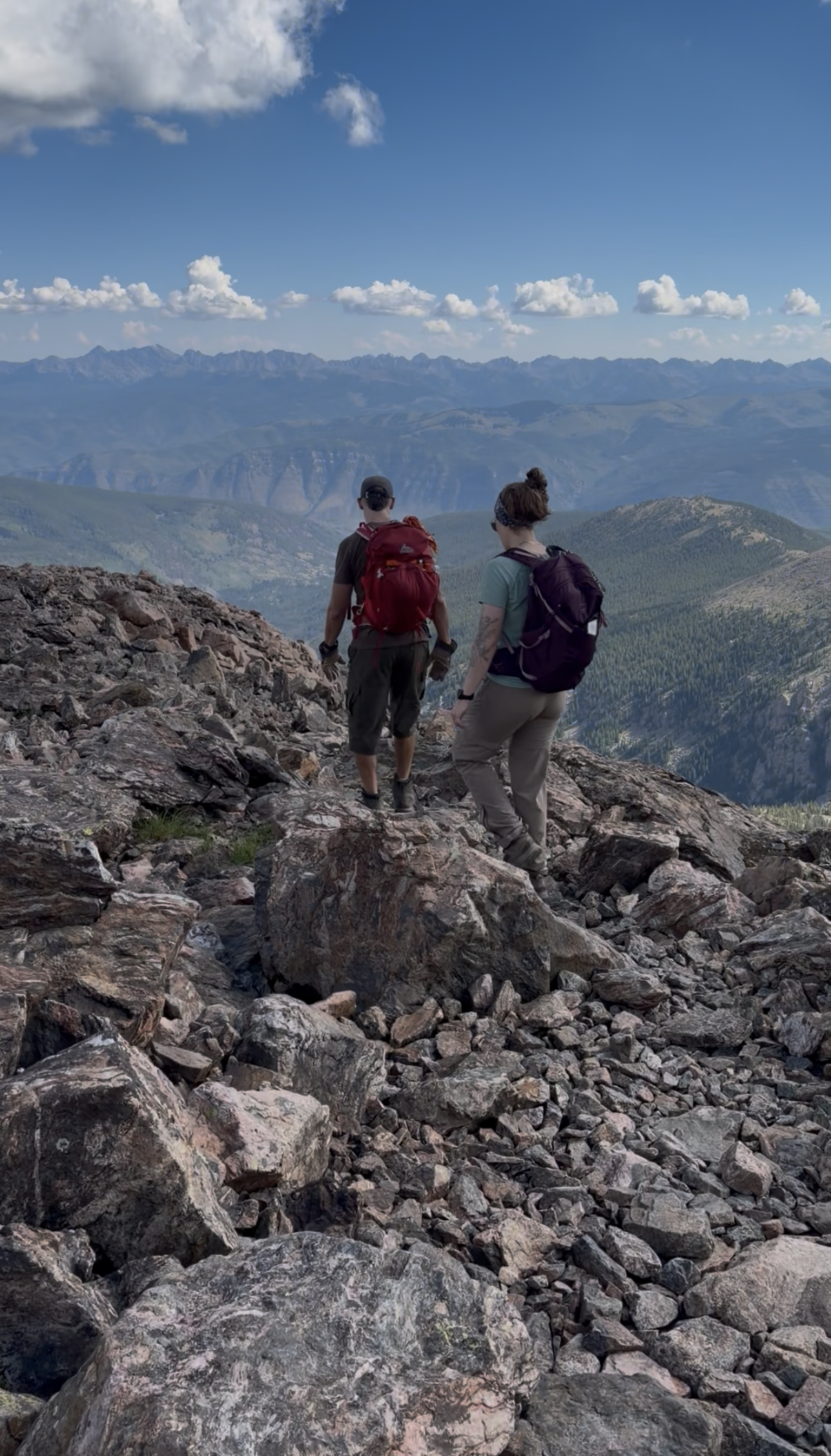
Going downhill is a whole other animal and flips the script. Every step your quads are working eccentrically, or contracting while lengthening, to control your body weight as it lowers to the next step. Fundamentally, this is a FAR HARDER job for the muscle to do, requiring significantly more strength and force to complete.
Biomechanically, the levers and moment arms of a descending stride are much tougher to control, and they shift more of that force onto your knees, since your glutes and hips can't share the load the way they did on the way up.
The end result is it loads your patellofemoral joint at several times your body weight with every foot strike. Do that for a few thousand steps on the way down from any 14er or large mountain, and it's not surprising your knees start to talk to you.
Your knees aren’t exploding or falling apart. They're just outpacing the strength and control the mountain is demanding of them.
Why Athletes and Lifters Aren't Immune Either
This isn't only a trail runner and hiker problem. We see it constantly in athletes and lifters too. Usually people who have to jump or change direction a lot, think tennis, basketball, or lacrosse. In lifters, its people who squat and deadlift heavy, but rarely train a slow, controlled eccentric. Strong concentrically, undertrained eccentrically.
Same issue, different landscape.
What Actually Helps
Rest and ice may help in the short term and settle things down temporarily. Foam rolling the quads feels good but doesn’t change anything structurally. They each won't fix the underlying issue, which is why the same pain shows up again and again on each of your descents.
How we fix this:
Knee strength: all issues rooted in force deficits benefit from grossly increasing strength. Mechanically, we can replicate these needs most closely with exercises such as leg extensions, wall sits, or sissy squats, all of which build raw quad and knee capacity in a controlled, low-risk setting before that strength ever has to show up on the trail.
Eccentric quad strength: step-downs, tempo squats, and yielding isometrics where controlling the lowering phase is the whole point. Easy on paper, difficult in practice. Slow, eccentrics under load, build a different kind of strength than a fast rep, and it's one your knees are begging for for descents. Can’t say I didn’t warn you, soreness is a major side effect that day after training when these show up.
Single-leg control — Bulgarian split squats, step-ups, and anything that forces one leg to stabilize without the other bailing it out. The stronger and more stable we get on one leg at a time, the more control you'll have with each individual foot strike, and the better your knees hold up over the last few miles of any descent.
None of this requires shutting down your other training. It requires prioritizing the specific quality and adaptation we want to develop. Dose everything consistently in your training and everything becomes that much better on your next climb.
If your knees are telling you the same story every time you head downhill, its not a sign to back off the mountains, it's a signal we need to bulk up the strength of your knees and legs. It's a fixable problem, and it's the kind of thing we work through with runners, hikers, athletes, and lifters alike every week.
If this sounds like your knees, reply to this email or book a visit and we'll figure out exactly where the gap is and build a plan to close it.
Helping athletes RESOLVE THEIR PAIN by CLEARLY DEFINING THE PROBLEM and IMPLEMENTING EFFECTIVE SOLUTIONS to get them back doing the activities they love!
If you are currently struggling with an injury or unable to perform in the activities you enjoy. Please follow the link to schedule a consultation call to discuss how we can help you.