Two people can have the same surgery, from the same surgeon, on the same day, and end up in very different places a year later. One is back skiing, running or lifting with confidence. The other is still dealing with a weak, swollen knee that they don’t trust and no clear way forward.
Most of the time, the difference comes down to a handful of things done well, done intentionally, and done consistently over the full length of rehab.
At Tundra Performance and Physical Therapy, we see lots of patients after their ACL surgery and typically the biggest issues come down to not prioritizing the right things, at the right time.
Here are the biggest considerations we prioritize in our ACL patients care to help ensure a smooth and effective recovery.
1. Get Your Knee Straight and Quiet, Early
The first few weeks set the tone.
The two biggest priorities early are getting full extension back and getting your swelling down.
Not being able to fully straighten your knee is one of the most common, and most stubborn problems after ACL surgery. It changes how you walk, overloads the front of the knee, and makes it hard to rebuild your quad later on. If we establish getting your extension back early, it becomes much easier to keep your extension throughout your rehab journey than it is to win it back later.
We typically want to see full extension back less than 2 weeks from your surgical date. If you still haven’t hit this checkpoint this quickly, don’t panic, it just means we need to prioritize this early in your care.
Swelling matters just as much. A swollen knee can shut the quad down. Ice, compression, elevation and smart activity levels in the early weeks protect the progress you're trying to make.
How we achieve this:
Daily extension work such as heel props, so the knee settles fully straight
ACTIVE quad strengthening that works end range from day one to get the quad firing again throughout its full range
Checking swelling every visit and adjusting the plan when the knee is reactive, rather than pushing through it
2. If we say we’re going to build up quad strength, we need to actually build up quad strength
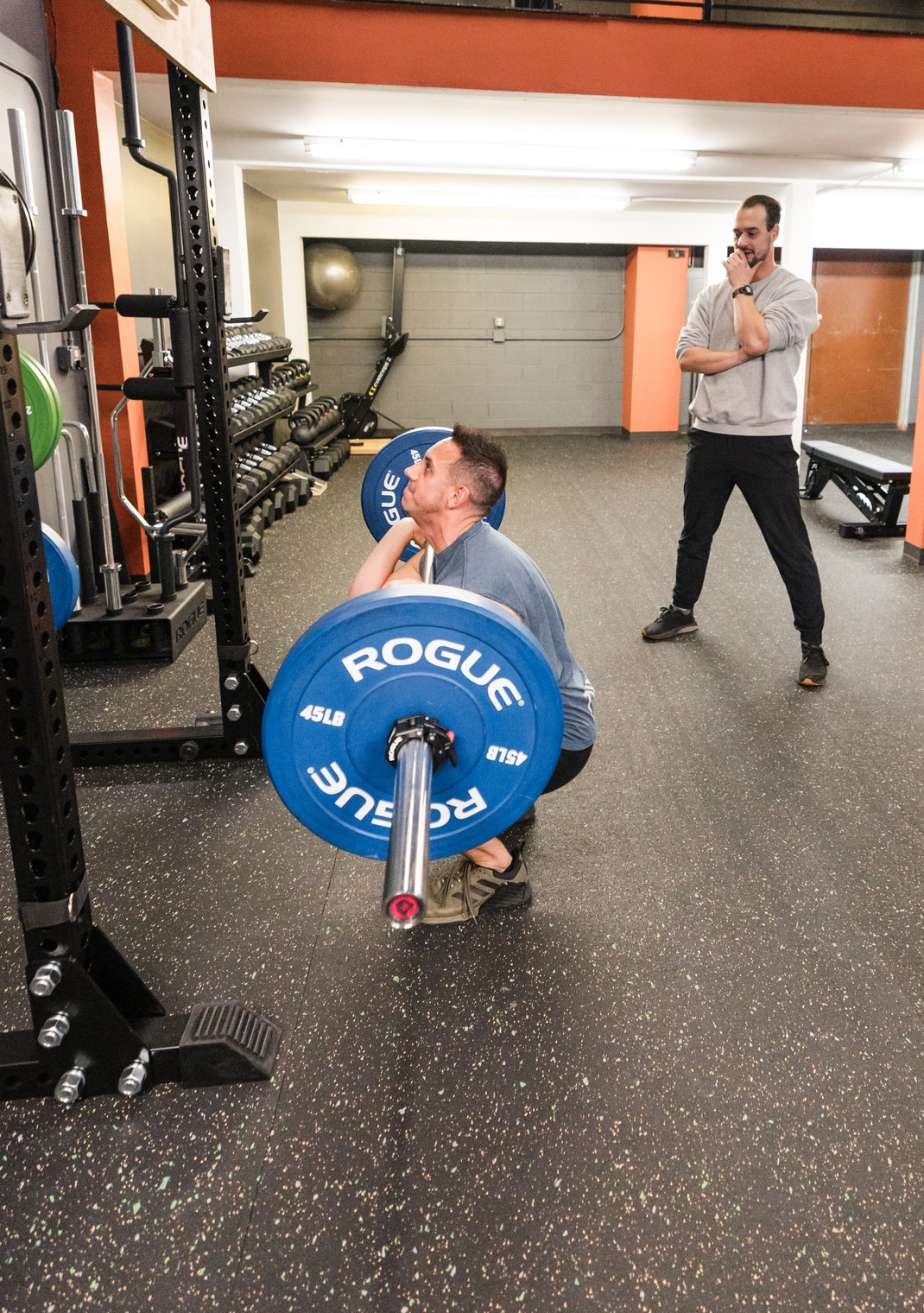
After ACL surgery, the quad loses size and strength fast. It can also be slow to come back. Quad weakness can hang around for years if it isn't trained hard enough.
That matters because quad strength is one of the strongest predictors of a good outcome. It's tied to how you land, how well you return to sport, your re-injury risk and your long-term knee health.
Band work and bodyweight exercises have their place early, but they won't finish the job.
Muscle grows under meaningful work. That means a steady progression to heavy, challenging strength training, guided by how your knee responds. Tools like blood flow restriction training can help bridge the gap while the knee isn't ready for heavy weight yet.
How we achieve this:
We prioritize quadriceps strength training early and often. This means split squats, leg extensions, leg presses trained hard enough to actually build strength
We build out full written programs, provided on an app, so were working hard not only at your PT sessions but at home and the gym as well
Blood flow restriction training throughout your rehab to build muscle not only with lighter loads but help with hypertrophy and complement heavier lifting later on
3. Relearn How to Bend Your Knee
After an ACL injury, your body learns to protect the knee, usually without you realizing it.
We call this concept learned disuse.
People shift their weight toward their other leg, lean their trunk, or keep their shin upright so the hip and ankle do the work instead of the knee. Sometimes it's just one thing. Sometimes we get a combination of all of them. This learned disuse can stick around long after strength comes back if we don’t address it.
We need to teach the knee HOW we want it to work again, and HOW we want it to do it.
Learned disuse can turn into quite the problem, because you can get strong in the gym and still avoid your knee in sport. Skiing at the front of your boots, cutting, landing and running downhill all require the knee to bend forward and accept weight. It's why one of the phrases our patients hear most often, and I sufficiently warn them ahead of time that they will be annoyed to hear it, is "bend your knee."
Once we establish the right movement patterns and it's consistent across multiple movements, we take it to jumping, landing, change of direction and uneven terrain, where compensations love to sneak back in under speed and fatigue.
How we achieve this:
Cueing a more forward shin angle in split squats, step-downs and medicine ball drop lunges so the knee learns how to properly accept weight
Video and movement analysis to see how your moving, how we can improve, and how can we get there
Progressing what we expect of the knee over time, starting with compound lifts all the way jumping, landing, deceleration, and change of direction keeping the same standard of how we want the knee to move and accept weight
4. Progress on Criteria, Not the Calendar
Time is one part of the decision making process.
Timeline for clearance is based upon tissue healing and certainly useful as rough guides, but individual differences and strength, while each having their own predictable timetables, don't always follow the same calendar.
To account for this, we progress patients on criteria based benchmarks over timelines alone. Before you start running, cutting or jumping, we want to see:
Full range of motion and a quiet, non-swollen knee
Good quad control and clean movement when lifting
Strength numbers that meet side-to-side and research-based targets on objective testing
Hop and landing tests that look and measure well
This approach keeps people from rushing ahead before they're ready. It also keeps people who are progressing well from being held back for no reason.
How we achieve this:
Testing quad and hamstring strength with a dynamometer at regular checkpoints, not just once at the beginning and once at the end
Comparing the surgical leg to the other side and to research-based norms for your size, so symmetry alone doesn't fool us
Deciding when you start running based on hitting strength targets, having a quiet knee and a clean single-leg squat, not just how many weeks it's been
Sharing the numbers with you, so you always know where you stand and what's next
5. Finish the job, physically and mentally
The most common way ACL rehab goes sideways usually isn’t a setback. It's stopping too soon. Around months 4–6 the knee often feels great. Then….. life gets busy and rehab fades out. But feeling fine and being ready aren't always the same thing.
The risk of re-tearing the graft, or tearing the ACL on the other side, is real for athletes who return to high level sports. Returning too early and without passing return-to-sport testing raises that risk significantly. Finishing rehab is the best insurance you have.
The mental side counts too. Fear of re-injury is common and completely normal, and it can quietly change how you move. Building confidence through graded exposure to the things that scare you, like that first ski run or first steep descent, is part of the process, we don’t want it to be an afterthought.
A full return-to-sport test battery before clearance: strength testing, hop tests and movement analysis
A graded plan back into your sport, like groomers before bumps or easy trails before technical descents
Talking openly about fear of re-injury and building confidence step by step, not just strength
Keeping a maintenance strength plan going after you're cleared, because protecting the knee doesn't stop at discharge
Bonus: work with someone who's done this many times
All five of these keys depend on one thing: who's guiding your rehab.
A physical therapist who has taken a lot of athletes through ACL recovery knows what to push and when to hold back. They measure progress instead of guessing, and they build the late-stage work around what you actually need to do on the mountain, the trail or the platform. A generic protocol and a printout of exercises ain’t it.
ACL rehab can be long, and the decisions that matter most are easy to miss if you haven't made them many times before. When you're choosing a provider, it's worth asking a few questions:
How many ACL patients do you work with, and how many of them are athletes?
How do you decide when I'm ready for the next stage?
Do you test strength objectively, or go by feel?
What does the return-to-sport phase look like, and how do you know I'm ready?
The right answers will tell you a lot about how your next year is going to go.
The bottom line
A great ACL recovery is built on a quiet, straight knee early, a quad trained with real work, movement patterns that put the knee back to work for your sport, progress identified by criteria and not a timeline, and the patience to see it all the way through.
If you're facing ACL surgery or you're somewhere in the middle of recovery, we'd love to help you build a plan that gets you back to what you love. Reply to this email or book an evaluation at Tundra Performance and Physical Therapy.
Helping athletes RESOLVE THEIR PAIN by CLEARLY DEFINING THE PROBLEM and IMPLEMENTING EFFECTIVE SOLUTIONS to get them back doing the activities they love!
If you are currently struggling with an injury or unable to perform in the activities you enjoy. Please follow the link to schedule a consultation call to discuss how we can help you.